
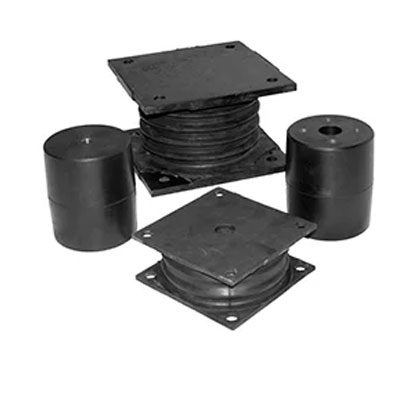
UMA RUBBER AND PLASTIC PRODUCT gives 100% in developing custom products as per client's requirement and their expectations. Kindly provide requirements in below attached questionnaire in case of developing new product.
Every machine has unique dynamic loads, center-of-gravity offsets, and vibration harmonic modes. Providing the 5 primary operating parameters below allows our engineering team to calculate natural frequency, static deflection, and compound chemistry for the ideal mount design.
Specify the machine type (e.g. Diesel Generator, Air Compressor, Chiller, Crusher, Centrifuge, Hydraulic Press, CNC Lathe, or Blower) along with operating RPM and vibration frequencies.
Provide the total operational weight in kilograms or metric tons, including motors, fluids, and dynamic workpieces, to determine static load per mounting point.
Indicate the number of mounting points or support legs (e.g., 4, 6, 8 points), foundation bolt size requirements, and whether the load is equally distributed or concentrated.
Specify minimum and maximum operating temperatures (°C). High-heat zones require heat-stabilized Silicone or EPDM, while outdoor or cryogenic installations require specific low-temperature polymers.
Detail exposure to lubricating oils, hydraulic fluid, diesel, coolants, acids, or solvents. This ensures we formulate oil-resistant Nitrile (NBR), Neoprene (CR), or Viton® elastomers.
Complete the questionnaire below and our engineering team will get back to you within 24 hours with a custom solution.
From initial questionnaire review to final mass production, our comprehensive manufacturing process ensures flawless vibration isolation performance.
We evaluate your machinery weight, center-of-gravity, and excitation frequency (RPM) to calculate theoretical static deflection and spring rates.
Our chemical lab formulates proprietary rubber compounds (NR, NBR, EPDM, Neoprene, Silicone) matched to temperature, solvent, and load requirements.
In-house precision mold design and metal fabrication allow rapid sample development and mechanical deflection/shear load testing.
Automated compression molding with strict bonding pull tests, dimensional verification, and ISO-compliant quality certification.